
Recent Posts
- HealthInvest June 2026: A Look Inside Australia’s Healthcare Innovations
- HealthInvest Returns for 2026: Meet the Companies Shaping Australian Life Sciences
- Lifesaving Capital: How impact investing is shaping the future of biotech
- Investor Relations: the quiet advantage powering ASX microcaps
- HealthInvest Sydney: Life Sciences in the Investor Spotlight
Archives
Lifesaving Capital: How impact investing is shaping the future of biotech
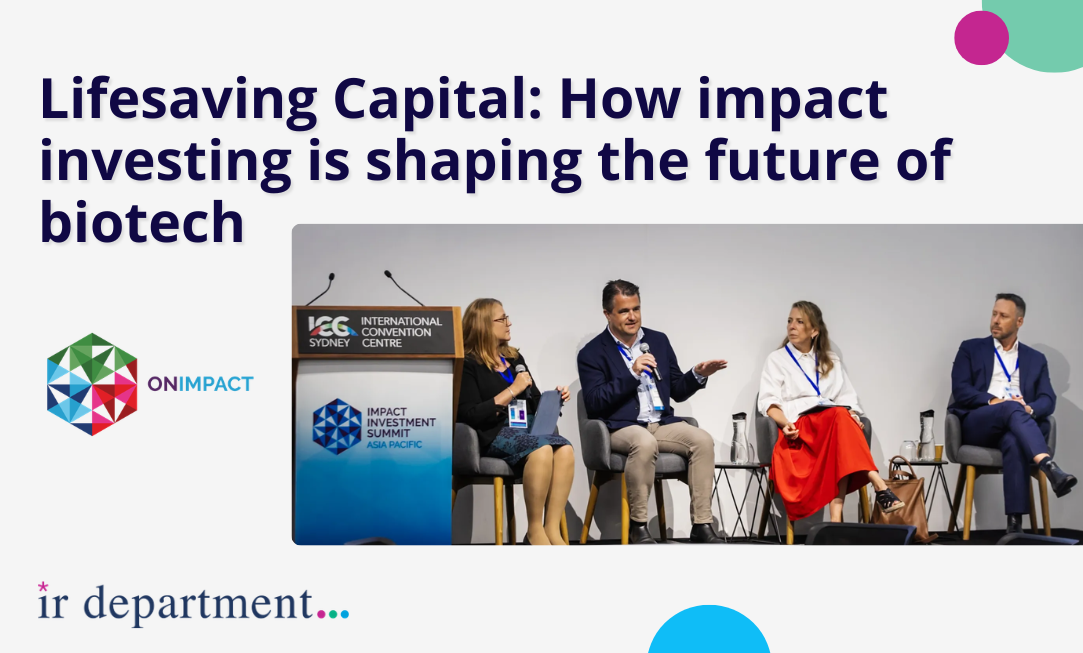
At the recent Impact Investment Summit in Sydney, a panel titled “Lifesaving: Impact Investing in Biotech Companies”brought together leaders from across investment, philanthropy and biotech innovation to tackle a critical question: “How do we fund the science that can save lives?”
Moderated by IR Department’s Managing Director, Jane Lowe, the discussion featured insights from:
- Dr Christian Toouli, CEO & Managing Director of FivepHusion
- Dr Justin Coombs, CEO of AusHealth
- Kerri Lee Sinclair, Director of Investment, AusBiotech
The promise, and challenges, of biotech investment
Biotechnology sits at a powerful intersection between some of the world’s most pressing health challenges, while also generating substantial commercial returns.
Yet, despite this promise, biotech remains notoriously difficult to fund.
Long development timelines, regulatory hurdles, and inherent scientific risks often deter traditional investors. The result? A persistent funding gap, particularly at the stages where innovation must transition from research into real-world application.
As Jane Lowe framed it, “Biotech may be one of the most meaningful ways to create measurable impact, but it’s also one of the hardest sectors to finance.”
For biotech innovators like Christian Toouli, the challenge is deeply practical. At FivepHusion, the mission is clear: address clinical need by optimising existing cancer drugs to improve patient outcomes. But translating that mission into funded progress is another story.
Early-stage conviction from scientists and clinicians can carry a company into initial trials, but scaling to the global clinical studies required for regulatory approval requires a different level of capital and expertise.
The real hurdle? Finding experienced investors who can validate both the clinical and commercial opportunity, and help bring others along.
This reflects a broader issue across biotech: it’s not just about raising capital, but raising the right kind of capital.
A key point of discussion across the panellists was that large pools of capital exist in philanthropic and charitable domains, but generally speaking, they are not directed toward specific biotech company investments. Rather, those funds might point toward university and academic research. While we do need funds pointed in that direction, the question is – could some of this impact capital be freed up to help these more mature life-saving innovations get all the way through to patients?
A different kind of investor
This is where organisations like AusHealth come in.
As Justin Coombs explained, AusHealth is a not-for-profit, tier-one charity that operates at the intersection of philanthropy and venture investment - what many now call venture philanthropy.
Rather than competing with well-funded universities or traditional venture capital, AusHealth focuses on a critical gap - the translational stage, where promising research needs support to move into clinical trials and fund ongoing product development.
Their approach is simple, but powerful:
- Deploy their organisational experience in medical research and drug development to assess promising biotechnology innovations
- Invest where funding can “move the dial”, backing projects with real clinical and commercial potential
- Bridge the critical funding gap between research and commercialisation
- Generate their own funds (through operational, revenue generative businesses) to stay independent, then funnel those funds back into philanthropy
- Achieve returns from successful investments and re-invest into new biotech innovations
Importantly, AusHealth doesn’t see itself as replacing traditional investors - rather complementing them. In fact, Dr Coombs has invited charities, family offices and other investors – parties with established infrastructure and operating models – to join AusHealth and co-invest in biotech companies to develop critical health innovations.
Impact versus return? And must they be mutually exclusive?
From an industry body perspective, AusBiotech’s Kerri Lee Sinclair offered a pragmatic view: investors are not opposed to impact, they just need clarity on clear pathways to value creation.
Biotech, she noted, is a stage-based asset class. Each step - from validating science to proving patient outcomes - requires different capital, different expectations and different risk tolerances.
The key is communication:
- What does the technology do?
- What does it unlock?
- What gives an investor confidence in the technology?
- What is the pathway forward?
Without clear answers, even the most impactful innovation struggles to attract funding.
One of the most debated questions in impact investing is whether financial returns and meaningful impact can truly coexist.
The panel’s answer: they must - but not always in the same way.
Kerri Lee Sinclair put it bluntly: “There will be things that change the world that will never see the light of day unless they make good market sense.”
In other words, impact alone isn’t enough - investors need to be confident in their understanding of where the next value inflection point lies, and how future funding will be secured. Justin Coombs added that while AusHealth is fundamentally philanthropic, it still avoids projects with no viable path forward.
Even for founders, this balance is shaping strategy. As Christian Toouli noted, a well thought out business plan overlaying excellent science is key.
“Today’s geopolitical and economic climate has made biotech investment even harder to secure, whilst the important medical need remains, thereby creating a clear opportunity for impact-driven capital to step in.”
In the case of FivepHusion, AusHealth recognised their impact opportunity and has backed the company with an important strategic investment. After significant due diligence, AusHealth stepped in as the company’s lead investor in their current capital raising, which is focused on funding the clinical trial progression of the company’s lead drug asset as potentially the first approvable drug for paediatric ependymoma, the third most common childhood brain cancer. FivepHusion and AusHealth are now looking for additional impact investors to co-invest into the company to complete the fundraising round.
Some precedents for where impact investments have facilitated breakthroughs in medicine, as well as substantial investor returns, include the International Rett Syndrome Foundation’s support for Australia’s Neuren Pharmaceuticals, which has developed the first therapeutic for Rett’s syndrome, and the Cystic Fibrosis Foundation, which backed Aurora Biosciences (now Vertex Pharmaceuticals) in the US, whose drugs have transformed the treatment of cystic fibrosis. These companies are regarded as standout investment success stories in their respective markets, whilst for the Foundations, they continue to make strategic impact investments into the industry’s next generation of drug candidates for their respective focus areas.
Unlocking more capital for biotech
So what needs to change? Each panellist offered a practical solution:
- Christian Toouli: Greater collaboration between charities, impact investors and innovators
- Kerri Lee Sinclair: Build global confidence by outlining clear pathways for companies to engage with international capital
- Justin Coombs: Work together - don’t reinvent the wheel
A common theme emerged: capital follows confidence.
A call to action for investors and innovators
The session closed with a clear message: unlocking capital in biotech isn’t just about funding individual companies; it’s about building a stronger ecosystem.
An ecosystem where:
- Science is understood
- Risk is contextualised
- Capital is aligned with impact, and
- New and existing pools of philanthropic or charitable funding can be channelled into more mature biotech investments, funding the next stages of promising projects that have advanced beyond university research.
As Kerri Lee Sinclair reminded the audience: “Whilst we need to identify credible capital pathways, we must also recognise that patient treatment and outcomes remain central to the entire process.”
Because if the sector gets this right, the returns won’t just be financial.
They’ll be measured in lives improved and lives saved.
To learn more about impact investment opportunities in the biotech sector, please reach out directly to the panellists via the following contact details.
- Jane Lowe, Managing Director, IR Department: jane.lowe@irdepartment.com.au
- Dr Christian Toouli, CEO & Managing Director, FivepHusion: c.toouli@fivephusion.com
- Dr Justin Coombs, CEO, AusHealth: jcoombs@aushealth.com.au
- Kerri Lee Sinclair, Director of Investment, AusBiotech: klsinclair@ausbiotech.org